

the services

the Courses

the podcast
A certified sex therapist and existential psychotherapist committed to thoughtful conversations about love, desire, & embodiment
Meet Dr. Emma

Subscribe to the Intimate Philosopher on:
Apple | Spotify | Amazon | Other Apps
On Riding Blind
Dr. Emma Smith and Dr. Alivia Stehlik on flow state in relationships, why the most engaged experiences are the ones you cannot do passively, and what a motorcycle taught one of us about trusting someone more than she trusted herself.
Summary
You have done it, probably this week. Driven a route you know by heart and arrived at your exit with no memory of the last ten minutes. Where were you? Nowhere in particular. The road was easy enough that being present became optional, and some part of you took the option. Now put the same person on the back of a motorcycle. That drift does not happen. You never wake up at your exit wondering where you have been, because the machine keeps you here.
This episode picks up a thread we started two weeks ago with flow state — that condition where the challenge in front of you meets your ability closely enough that you stop watching yourself and simply do the thing. Before going further, the caveat in the recording: most of the research on flow has been done with athletes, neither of us is a neuroscientist, and we are borrowing the concept rather than reporting a finding. The point is not to hand you a capital-T truth about your nervous system. It is to offer a different window into how presence actually works.
Focus of the Episode
Alivia, who has spent a decade as a physical therapist in human performance, makes the case that flow is not reserved for elite athletes — that it shows up in ordinary lives, wherever your skill and the demand of the activity happen to meet. For me, of all things, it arrives in research and writing. I sat down at my desk one evening, looked up at what felt like five minutes later, and an hour was gone. Brain-in-a-jar territory, the accomplished nerd most at home inside her own head. For Alivia it lives in the gym, and on the motorcycle, where — as she puts it — there is no passive riding.
That line is the whole episode in miniature. On a bike you feel the temperature shift mile to mile, feel the humidity change, feel grit in the air land on any exposed skin. You smell every restaurant, every passing car’s fumes, whether it rained an hour ago. The same route is never the same ride, because the thing demands that you notice all of it. Engagement is not a mood you summon. It is the price of admission, and the machine collects it whether you meant to pay or not.
The Night the Bubble Burst
I got my motorcycle license at forty. Rode on my own for a while. And one afternoon I caught myself going faster than I had registered, and it felt good, right up until I understood exactly how little sat between me and the pavement. The thought arrived clean and cold: how easily I could die. And close behind it, the more dangerous one — that if I kept thinking it, I would. My mother was a burn-unit and ICU nurse, and she raised me on a line that has landed wrong for plenty of people I have repeated it to but never once for me: panic is a luxury. I put the fear back where it belonged, gave the road my attention, and got home.
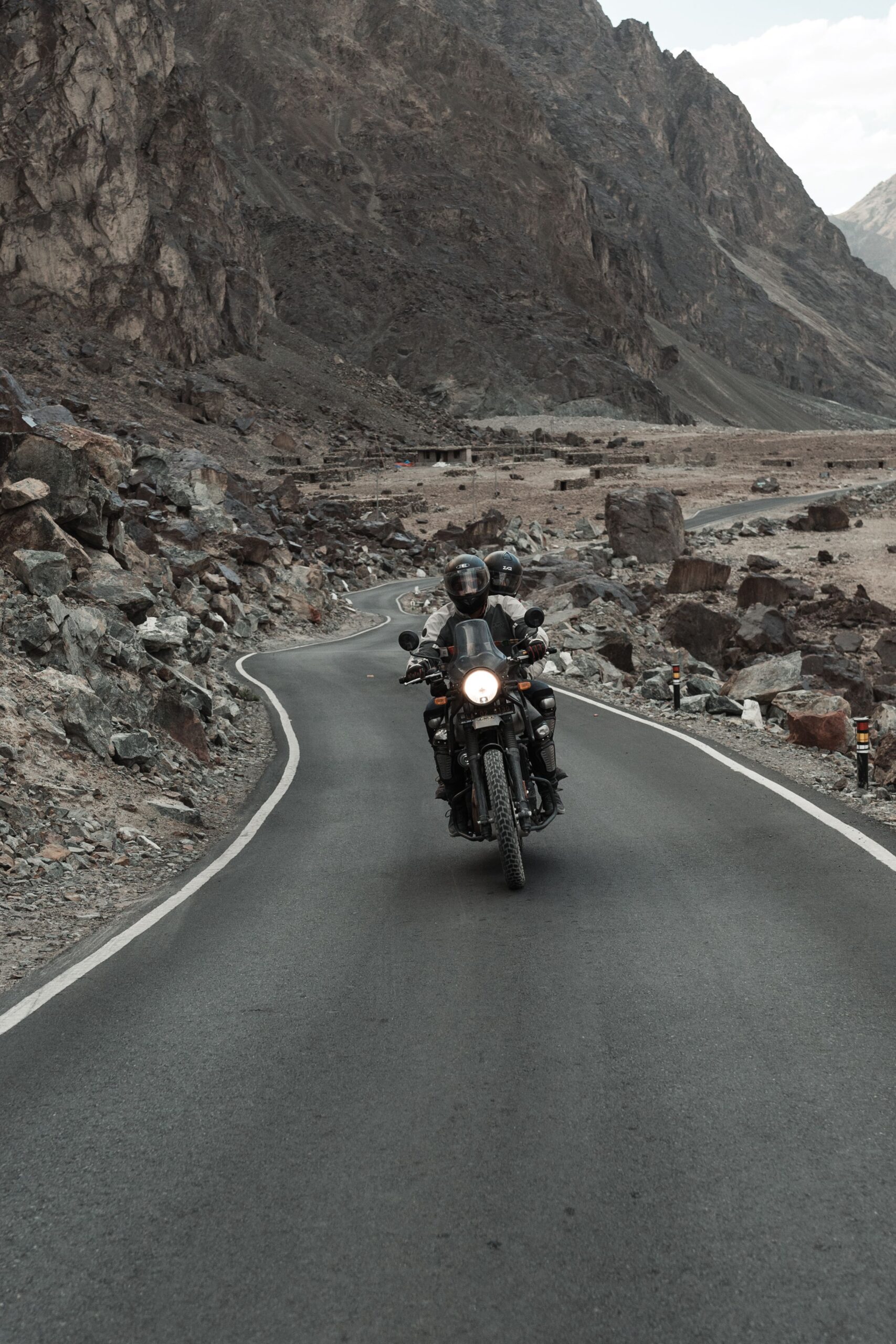
What I never reached, riding alone, was ease. The place I actually found flow was on the back of Alivia’s bike. And here is the part worth slowing down for. A passenger on a motorcycle cannot see in front of her. Try to look around the rider and you throw off the balance of the machine for both of you. You are, in the most literal sense, riding blind, and the only way through is to trust the person in front of you more than you trust yourself. I could drop into the whole alive surface of it — the smells, the shifting temperature, the road coming up underneath — because I was not afraid. The fear was gone because the trust was there.
A good passenger is not a passive one
This is where the analogy stops being about motorcycles. Being a good passenger is its own skill, not the along-for-the-ride thing people assume. Part of why I took the course was to become a better passenger — to understand the whole endeavor from the operator’s side — and the benefit ran in both directions. Alivia bought me a jacket and a helmet before the first ride, because you do not hand someone the bare-minimum exposure to risk and call it shared. She rides inside boundaries she set long before she met me: not when she is angry, not when she is grieving, not tired, not drinking. The stakes get matched. Both people own their part of a thing that is, plainly, dangerous.
You will get into a car with almost anyone — a friend, a stranger, whoever the app sends. You do not get on the back of a motorcycle with a stranger. Relationships tend to get sold on the car model: pass-the-test-once-and-you-are-set. It is a bad model. Skill declines without practice. The risk stays real, the kind that breaks your heart and tears your life apart, and so does the payoff: an engaged, awake partnership you get to inhabit rather than commute through.
Late in the conversation Alivia reaches for Pirsig — Zen and the Art of Motorcycle Maintenance — and the question that book will not release: how do you recognize quality when you see it, even when you cannot say what it is? She nearly opens the whole thing and then, on purpose, sets it down for another day. What she will commit to now is smaller and harder to argue with. Quality is not passive. You cannot have it without engagement, in a piece of writing or in a life built next to someone.
This one is for you if…
This one is for you if you’ve been riding through your relationship on autopilot, but you want to wake up.
A question worth considering
Where have you been riding on autopilot, trusting the route is familiar enough to run without you? And what would it take to trust your partner enough to close your eyes and feel the road?
Moments Worth Noting
There is no passive motorcycle riding.
You better trust the person who is in front of you enough that you’re ok literally riding blind.
Panic is a luxury.
The risk is high. You [could] get your heart broken, you get your life torn apart. But the payoff is really high, too.
Quality is not passive.
Chapters
- 00:00 — Thirty episodes in
- 08:20 — Back to flow state (and the athlete caveat)
- 10:19 — Where flow state actually finds you
- 15:14 — There is no passive motorcycle riding
- 17:03 — Compression and expansion of time
- 20:10 — The night the bubble burst
- 26:15 — Trusting someone more than yourself
- 30:03 — A good passenger is not a passive one
- 35:00 — Matched stakes: the jacket, the helmet, the boundaries
- 38:16 — Quality, Pirsig, and why it can’t be passive
- 43:04 — Closing, and the book worth reading
The Receipts
If you love when things get EXTRA nerdy, this section of the show notes is for you!
Where things get nerdy.
- Zen and the Art of Motorcycle Maintenance, Robert M. Pirsig — the meditation on quality Alivia keeps buying new copies of. Its follow-on, Lila, continues the inquiry.
- Flow state — the concept originates with psychologist Mihály Csíkszentmihályi, offered here as general background rather than anything we claim expertise in. The framing in this episode comes from the TEDx Nashville Science of Woo series the hosts attended this summer.
Dr. Emma is hosting a free virtual masterclass this August on investing in your relationship before crisis makes the decision for you. Reserve your spot for August 14: Reserve your seat!
Nashville friends: Dr. Emma will be speaking at Stimulate, a sexual wellness symposium downtown on August 3rd on the philosophy of pleasure in the 21st century.
💌 Stay Connected
If this episode resonated with you, send it to someone you think needs to hear it — or someone you think is waiting for permission to stop waiting.
You can find Dr. Emma on Instagram at @emmasmithphd and Dr. Alivia on Instagram at @aliviastehlikpt If there’s a question you’ve been almost afraid to ask, the show wants it @theintimatephilosopherpodcast
Some of the best conversations begin with a question someone was almost afraid to ask. You’re welcome to ask it here.
Send us a comment: Comment Form
Register for the Masterclass and download your free gift: Masterclass Reservation
Support for the Show
Support for the show is made possible with the help of Nine to Kind Planners.
If you’ve heard me talk about the planner I actually use — it’s from Nine-to-Kind. It’s one of the few tools that helps me stay organized and grounded without feeling like another task to manage.
You can explore it here: https://ninetokind.com and use code EMMA20 for 20% off.
Keywords: existential sex therapist, flow state in relationships, motorcycle metaphor, vulnerability and trust, co-created intimacy, emotional intimacy, long-term relationships, embodiment, presence, engaged relationship, zen and the art of motorcycle maintenance, modern intimacy, couples therapy podcast, existential-integrative therapy
Quality Requires Engagement
older posts
older posts
newest posts
© 2025 Soliloquie
Step into the inner circle—exclusive insights and your gateway to transformation.
The VIP List
Soliloquie offers tailored psychotherapy for trauma recovery, personal growth, and relational healing.
Soliloquie
No Surprises Act: You have the right to receive a Good Faith Estimate of what your services may cost.


Serving clients in TN, DC, VA, & TX


Comments will load here